Free Printable Word Searches: How Tangible Puzzles Build Vocabulary, Defeat Screen Fatigue, and Bring Focus to Modern Daily Life
Discover why humble, free printable word searches remain one of the most powerful, screen-free educational tools for American households. From diffusing the 7:30 PM iPad battle and mastering Friday spelling lists to calming busy elementary classrooms and preserving memory in seniors, explore how tangible paper puzzles transform daily routines.
- › 1. The 7:30 PM Screen Battle: Why Paper Puzzles Beat Pixels
- › 2. Kindergarten to 5th Grade: Decoding the Science of Orthographic Mapping
- › 3. The Teacher’s Secret Weapon: Morning Bell Work & Sponge Activities
- › 4. Road Trips & Restaurant Tables: Screen-Free Emergency Entertainment
- › 5. Brain Health Across Decades: Why Grandparents Love Tangible Word Grids
- › 6. Customizing Puzzles for Friday Spelling Tests & Thematic Units
- › 7. The Thrifty Parent’s Guide: Printing, Laminating & Ink Longevity
- › 8. How to Build Your Custom Word Search in Under 60 Seconds
1. The 7:30 PM Screen Battle: Why Paper Puzzles Beat Pixels
If you have raised a child in an American household over the past decade, you know this exact moment. It is 7:30 on a Tuesday evening. Dinner dishes are soaking in the sink, backpacks are slumped by the kitchen island, and bath time is supposed to start in fifteen minutes. Your seven-year-old is sitting on the living room rug, clutching an iPad, watching brightly saturated shorts or tapping frantically on an algorithmic video game designed by Silicon Valley engineers to maximize dopamine loops.
You gently say, "Hey buddy, five more minutes, then tablet goes away." Five minutes pass. You ask again. You reach down to press the power button—and instantly, the living room erupts into a full-scale emotional storm. Tears, slammed cushions, and angry protests fill the room.
This is not bad parenting, and it is not a "bad kid." It is basic neurochemistry. When a child stares into a backlit glass screen firing sixty frames of high-contrast motion per second, their brain stem operates in a state of hyper-arousal. Abruptly ripping away that hyper-stimulation causes an immediate drop in dopamine, triggering an emotional meltdown that leaves parents feeling exhausted and defeated before bedtime even begins.
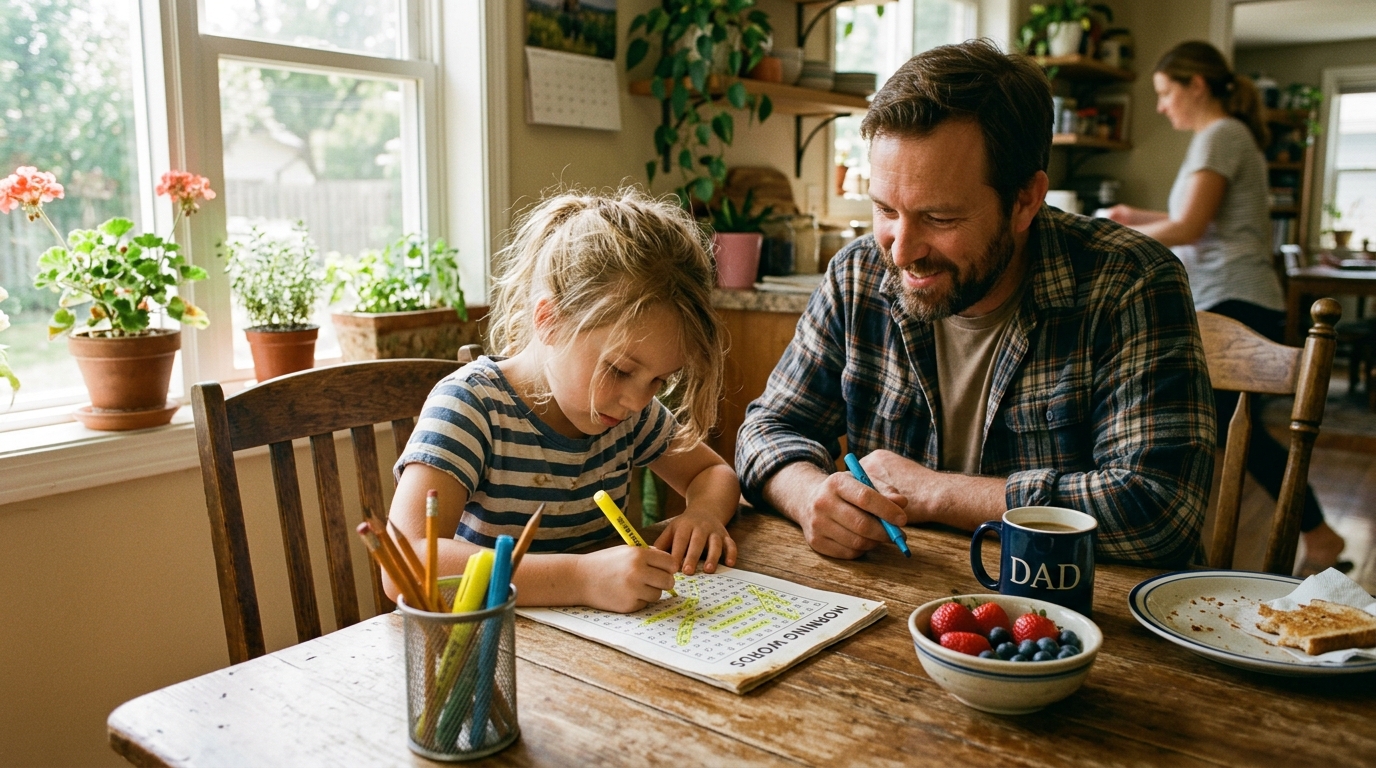
This exact exhaustion is driving millions of families back toward the humble simplicity of free printable word searches. When you place a freshly printed sheet of paper on the kitchen table alongside a classic yellow highlighter or a freshly sharpened No. 2 pencil, something remarkable happens. The sensory experience downshifts immediately:
Zero Blue Light Interference
Paper relies on ambient room lighting. It does not suppress evening melatonin production, allowing your child's natural circadian rhythm to prepare for restful sleep.
Closed-Loop Completion
A printed puzzle has a defined finish line. Once all twelve words are found, the task is complete. There are no next-level autoplay algorithms or loot boxes keeping them hooked.
Tactile Motor Feedback
Gliding a highlighter across paper engages fine-motor proprioception, grounding an overstimulated nervous system in a way tapping smooth glass never can.
Printable word searches are not an archaic relic of 1990s elementary school classrooms; they are a modern mental oasis. They represent a low-cost, zero-friction bridge between after-school homework chaos and peaceful bedtime routines.
2. Kindergarten to 5th Grade: Decoding the Science of Orthographic Mapping
Many parents view word searches as pure busywork—a quick distraction to buy twenty minutes of quiet time while cooking dinner. But cognitive psychologists and reading specialists understand that scanning a letter matrix triggers an essential neurological process called orthographic mapping.
Orthographic mapping is the mental mechanism through which our brains permanently bond the visual spelling of a word (its graphemes), its spoken sound (its phonemes), and its meaning in long-term memory. When an adult reads the word "because" or "elephant", you do not sound out each letter individually. Your brain recognizes the entire visual configuration in less than 200 milliseconds. That word has become "sight vocabulary."
How does an emerging reader reach that stage? By repeatedly analyzing letter sequences in exact order. Notice what a child does when hunting for the word "BECAUSE" in a 12×12 grid:
-
Anchor Identification: The child's eyes scan the rows for the capital letter
B. This exercises visual discrimination against similar-looking letters likeP,D, andR. -
Directional Verification: Once a
Bis spotted, the child looks in all eight adjacent grid cells for the letterE. If anEis found to the right, they immediately project their gaze to the next cell to verifyC. -
Sequential Chunking: By the time they reach
A-U-S-E, their brain has rehearsed the internal spelling sequence three or four times.
Compare this to traditional flashcard drilling. When a child stares at a flashcard held up by a parent, frustration builds quickly if they cannot guess the word. The flashcard demands instant retrieval under pressure. A word search, by contrast, gamifies the search. The letters are guaranteed to be there; the child simply has to become a detective. That shift from anxiety-driven recall to curious investigation changes everything.
For children with mild dyslexia or tracking difficulties, start with a 10×10 grid restricted strictly to forward horizontal (left-to-right) and vertical (top-to-bottom) words. Avoid backward or diagonal orientations until the child feels totally confident tracking across linear rows without skipping lines.
Developmental Milestones: Matching Grid Difficulty to Elementary Grades
One common mistake well-meaning parents make is printing a massive 20×20 grid for a first grader. Confronted with four hundred crowded letters, a six-year-old’s visual cortex experiences immediate cognitive overload. The child throws their hands up and says, "I can't do this!" To foster genuine confidence and spelling fluency, tailor the puzzle matrix to your child's developmental reading stage:
Phase 1: Pre-K and Kindergarten (Ages 4–6) • 10×10 Grid
Focus on 3- to 4-letter CVC (Consonant-Vowel-Consonant) words like CAT, DOG, SUN, RED, BIG. Restrict search direction strictly to horizontal (left-to-right). At this stage, the primary objective is teaching print directionality—reinforcing that in English, reading moves consistently from left to right.
Phase 2: First and Second Grade (Ages 6–8) • 12×12 Grid
Introduce high-frequency Dolch and Fry sight words (ABOUT, COULD, THERE, WATER, EVERY) along with standard vertical (top-to-bottom) words. Searching vertically trains the eyes to track down columns, strengthening the visual scan paths necessary for reading multi-line chapter book paragraphs.
Phase 3: Third to Fifth Grade (Ages 8–11) • 15×15 Grid
Introduce diagonal words (down-right and up-right) and multi-syllabic academic vocabulary (FRACTION, ECOSYSTEM, REVOLUTION, EXPERIMENT). Diagonals challenge children to calculate geometric angles mentally, strengthening spatial reasoning and cognitive flexibility.
Phase 4: Middle School & Family Challenge (Ages 11+) • 18×18 Grid
Incorporate backward words (right-to-left, bottom-to-top) and intersecting letters. Solving backward words forces the brain to mentally reverse spelling sequences, cementing tricky letter orders (such as distinguishing "FRIEND" from "FREIND") under engaging conditions.
3. The Teacher’s Secret Weapon: Morning Bell Work & Sponge Activities
Step into any American public school classroom between 8:05 and 8:25 AM. The scene is controlled turbulence. Twenty-six students are streaming through the doorway, unzipping damp winter parkas, emptying lunchboxes, handing in permission slips, and chatting excitedly about yesterday's playground drama.
For the classroom teacher, those first twenty minutes are a high-wire logistical balancing act: taking official state attendance records, logging cafeteria lunch counts, handling nurse medication passes, and calming students who arrived overwhelmed from a chaotic morning bus ride.
This is where veteran educators rely on sponge activities—purposeful, quiet academic tasks that absorb restless energy without requiring teacher intervention. A custom printable word search waiting on each student's desk is the gold standard of morning bell work for three practical reasons:
- Immediate Task Initiation: Children know exactly what to do the second they sit down. No complicated verbal directions or whiteboard instructions are needed. They pull out their pencil and get to work.
- Natural Classroom Volume Control: Searching for hidden letter patterns demands sustained visual focus. Within sixty seconds of handing out word searches, the classroom decibel level drops from a roar to gentle whispers.
- Effortless Tiered Differentiation: A teacher can easily print two variations using our Word Search Generator: a 10×10 grid with 8 words for students needing reading intervention, and a 15×15 grid with 16 words and diagonals for advanced early finishers. Both worksheets look identical from across the room, preserving student dignity while meeting everyone at their exact developmental level.
Furthermore, in an era where classroom supply budgets are notoriously pinched—forcing teachers to spend hundreds of dollars out of pocket every semester on paywalled worksheet subscriptions—having access to an entirely free, ad-free generator is a massive relief.
4. Road Trips & Restaurant Tables: Screen-Free Emergency Entertainment
Picture this: It is 6:15 PM on a Friday. You are seated in a crowded Texas Roadhouse booth or a local pizza parlor. The restaurant is running on a 40-minute food delay. The noise is deafening, your four-year-old has already spilled their ice water, and your eight-year-old is slumping sideways in the booth complaining, "I'm starving, when is the food coming?"
The default reaction of modern parenting is to reach into your purse or back pocket, unlock an iPhone, and hand it over. It buys instant silence. But it also isolates the child into a private digital bubble. When the food finally arrives, pulling them away from the screen sparks an argument, and dinner conversation is ruined.
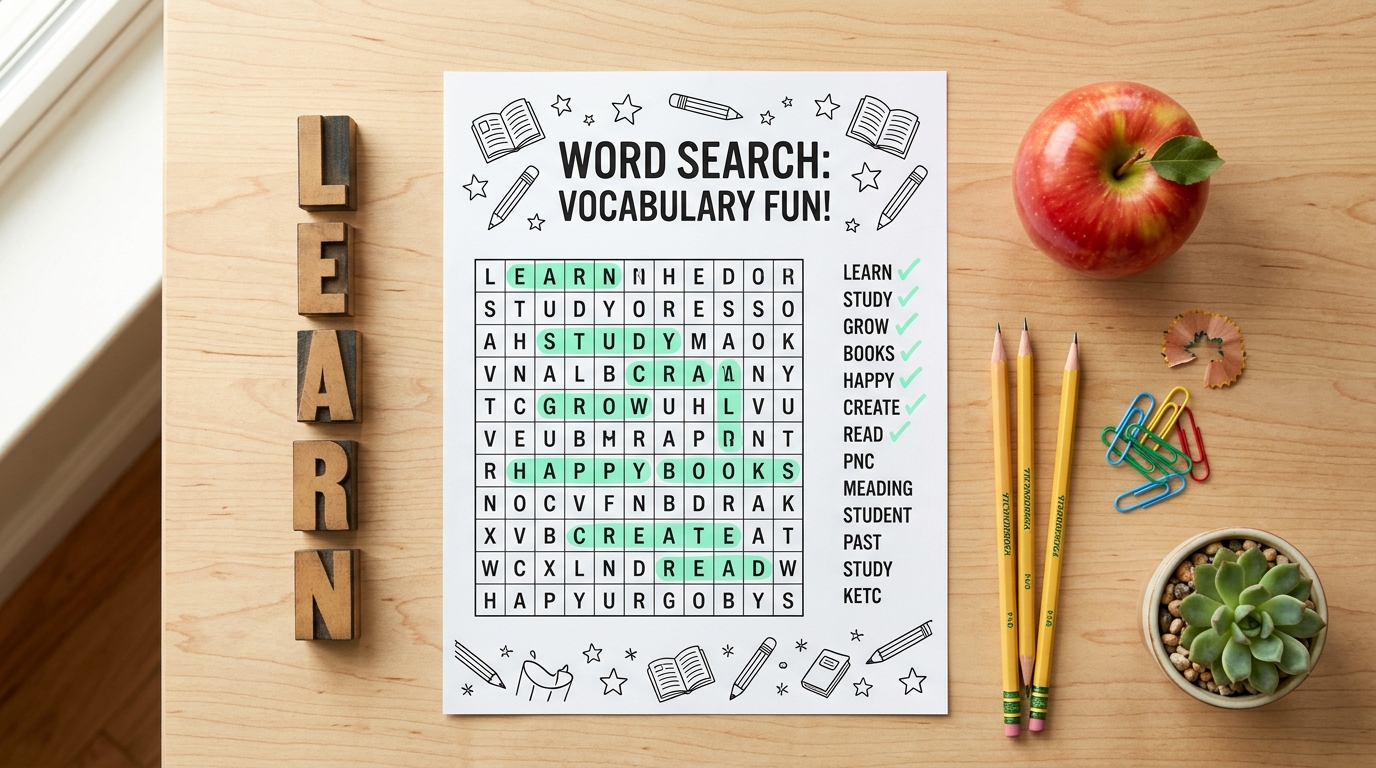
Now consider the alternative: keep an inexpensive $1.50 plastic clipboard in the glove box of your car. Before heading out for the weekend, print three or four themed word searches from our free collection. Clip them to the board with a dual-color pen or a yellow highlighter.
When you slide that clipboard onto the restaurant table, something magical happens. A word search is inherently social. A sibling looks over and says, "Hey, I see DOLPHIN right there on the third row!" A parent can participate between sips of iced tea: "Look at the bottom corner for an S." Instead of isolating your children in separate digital silos, the humble paper puzzle turns a boring restaurant wait into a collaborative family game.
The same dynamic applies to other high-stress American parenting situations:
✈️ Airport Delays at Gate B14
Holiday travel means packed airport concourses, delayed departures, and scarce charging stations. While surrounding children grow restless and exhausted from continuous phone use, a clipboard of travel-themed word searches keeps kids anchored, calm, and happily occupied on the terminal carpet.
🏥 Pediatrician Waiting Lounges
When a child is feverish or anxious for a 45-minute medical wait, loud waiting room televisions or germ-covered communal toys increase stress. Handing a child a soothing, personal word search with an encouraging title ("Feel Better Soon, Emma!") brings comfort and peaceful distraction.
The "Two-Color Sibling Challenge"
If you have two children who tend to squabble in the backseat of the minivan during interstate drives along I-95 or I-80, try this simple cooperative technique. Hand them a single printed 15×15 word search on a clipboard. Hand one child a pink highlighter and the other a green highlighter.
The rule is simple: they take turns finding words from the bank. When Child A finds a word, they circle it in pink and check it off. Then Child B searches for the next word with green. Instead of fighting over whose turn it is to hold a tablet, they collaborate, cheer when someone spots a tricky diagonal word, and arrive at grandma's house laughing together.
5. Brain Health Across Decades: Why Grandparents Love Tangible Word Grids
While children benefit from word searches for spelling and vocabulary acquisition, an equally passionate demographic relies on them every single morning: American seniors and retirees.
Neuroscientists at major medical research institutions, including Harvard Medical School and the Mayo Clinic, consistently emphasize the value of "cognitive reserve." As the human brain ages, maintaining neural plasticity requires regular, enjoyable mental exercise. Word search puzzles stimulate several critical cognitive domains simultaneously:
- Visual-Spatial Scanning: Searching across rows, columns, and diagonal vectors exercises the occipital and parietal lobes responsible for spatial orientation and pattern recognition.
- Working Memory Retainment: Holding a 7-letter word in mind while scanning through random letters exercises the prefrontal cortex without overwhelming it.
- Selective Attention: Filtering out irrelevant "distractor" letters to pinpoint the correct sequence trains inhibitory control, a skill that naturally declines with age.
Crucially, word searches provide non-threatening cognitive stimulation. Unlike crossword puzzles or trivia quizzes, which test factual memory and can induce anxiety or frustration in seniors experiencing early cognitive decline, a word search provides all the answers right in front of the solver. The information is not missing; it simply needs to be discovered. This creates a relaxing, dopamine-releasing state of flow that brings profound comfort.
However, millions of seniors face a practical barrier with commercially published puzzle books found at grocery checkout lanes: the print is shockingly tiny. Cheap newsprint paper bleeds through when marked with felt-tip pens, and standard 8-point fonts strain aging eyes and bifocals.
With our Word Search Puzzle Generator, you can select standard 10×10 or 12×12 dimensions that output bold, crisp, high-contrast letters on crisp white US Letter paper. It is an act of love to print a fresh stack of five large-print puzzles each Sunday morning for an aging parent or grandparent.
Active Meditation for Busy Parents: Defeating Evening Overwhelm
Cognitive benefits are not reserved exclusively for seniors. In our hyper-connected modern lives, adult parents are plagued by "pop-up fatigue"—the mental exhaustion caused by juggling work Slack notifications, mortgage payments, pediatric dental appointments, and soccer carpool logistics.
Sitting down with a hot cup of chamomile tea at 9:30 PM and spending fifteen minutes solving a quiet, physical word search acts as an active meditation. Because your brain must actively scan letters sequentially, you cannot multitask. You cannot mentally argue with an email or obsess over news headlines while searching for the word "ECLIPSE". The mind gently anchors to a single, peaceful focus, easing the transition into deep, restorative nighttime sleep.
6. Customizing Puzzles for Friday Spelling Tests & Thematic Units
One of the greatest frustrations parents face with store-bought puzzle workbooks is relevance. A generic $8 workbook bought at Walmart might feature word searches on random topics like 1950s train locomotives or kitchen appliances—topics that do not connect to what your child is actually studying in school this week.
When you use a custom tool, you can align the puzzle directly with your child's weekly curriculum. Here are four practical curriculum integrations that take less than two minutes to set up:
The Friday 100% Secret
Every Monday, elementary teachers send home a spelling list of 10 to 15 words. Paste that exact list into our generator. Print two copies: one for Monday afternoon, one for Thursday evening review. Children learn the spelling order visually before ever being tested.
Deepening Thematic Memory
Studying the water cycle? Input words like EVAPORATION, CONDENSATION, PRECIPITATION, RUNOFF. Learning US Geography? Generate our built-in 50 States preset to familiarize kids with state names before map quizzes.
Phonetic Pattern Building
For children learning English as a second language, English spelling rules can feel arbitrary. Grouping words by phonetic families (e.g., words ending in -IGHT: BRIGHT, FLIGHT, LIGHT, NIGHT, SIGHT) helps them recognize orthographic patterns visually.
Personalized Milestone Fun
Hosting a birthday party for your 8-year-old? Type the birthday child's name, their favorite food, pets, best friends, and hobbies. Print 15 copies on colored pastel paper as a personalized party table activity!
7. The Thrifty Parent’s Guide: Printing, Laminating & Ink Longevity
We have all had that sinking feeling: you click print on an educational website, only to discover that the printable features a giant, full-color illustrated border and a dark navy blue header that drains half your printer's color ink cartridge in a single pass. Replacement printer ink is one of the most expensive liquids on earth by volume, and no family should have to spend $40 on ink cartridges just to print learning sheets.
Every template on FamilyPrintable is intentionally engineered with ink-smart architecture:
- Zero Heavy Flood Fills: Grids use thin, crisp 1-pixel borders and clean typographic spacing rather than ink-heavy solid blocks.
- Black & White Optimized: While our preview displays elegant accents, the worksheet renders in pure high-contrast monochrome when printed on standard black-and-white laser or draft inkjet settings.
- Standard US Letter (8.5 × 11") Margins: Engineered with 0.5-inch safety margins so no letters or word bank items are clipped by home printer roller mechanisms.
If you want to use the same word search puzzle multiple times across a classroom or homeschool group, do not reprint it every day. Purchase a 10-pack of clear, heavy-duty dry-erase pocket sleeves (available online for around $12). Slide your printed worksheet inside. Children can use fine-tip low-odor dry-erase markers to circle words. When finished, a single swipe of a microfiber cloth or paper towel restores the sheet to brand-new condition for the next student!
Best Pens & Highlighters for Clean Letter Tracking
Standard dark markers (like black or dark blue permanent Sharpies) tend to bleed through thin 20 lb copy paper, obscuring letters on the reverse side and blacking out the puzzle grid so words can no longer be checked. For the best sensory and visual experience, we recommend pairing printed worksheets with:
- Chisel-Tip Fluorescent Yellow or Mint Highlighters: The semi-translucent ink illuminates the found word without obstructing letter recognition for answer grading.
- Erasable Gel Pens (like Pilot FriXion): Perfect for perfectionist kids who get anxious if they accidentally circle the wrong diagonal row. A quick friction-eraser rub clears the mistake without tearing the paper.
- Standard 24 lb or 28 lb Bright White Paper: While standard 20 lb multipurpose printer paper works great, stepping up to 24 lb paper costs only $2 more per ream and provides a smooth, substantial, bleed-resistant canvas that feels satisfyingly premium in small hands.
8. How to Build Your Custom Word Search in Under 60 Seconds
Creating a tailor-made puzzle for your classroom, kitchen table, or road trip takes less than a minute with our interactive tool. Here is the step-by-step workflow:
- Select a Preset or Enter Words: Open the Word Search Puzzle Generator. Click any of our one-touch vocabulary presets (Sight Words, US States, Solar System, Ocean Life, Road Trip, Kindness), or paste your own custom word list into the text box.
- Set Your Grid Size & Difficulty: Choose 10×10 for younger kids (K–1st), 12×12 for standard elementary grades, or 15×15/18×18 for middle school and adults. Adjust difficulty to allow diagonals or backward placements as desired.
- Personalize Title & Name: Add your child's name and school, plus custom instructions like "Good luck on your Friday spelling words!"
- Print Student Sheet & Answer Key: Click "Print Now" to generate a vector-sharp copy. Then check the "Show Answer Key" toggle in the tool settings to print a teacher solution copy with highlighted letters for instant, effortless grading!
Combine your word search with our other free printable learning tools to create a complete, screen-free morning routine:
- Handwriting Name Tracing Sheet: Perfect companion for kindergarten and 1st graders practicing letter formation.
- Multiplication Chart Worksheet: Master times tables from 1–12 with custom fill-in practice grids.
- Class Timetable Generator: Keep track of weekly school periods, specials, and homework deadlines.
- Homework Planner Printable: Eliminate afternoon backpack anxiety with daily assignment checklists.
Small analog habits compound into monumental household peace. This week, turn off the living room screen twenty minutes earlier, print a fresh word search, hand your child a colored highlighter, and enjoy the calming rhythm of focus.
Customize & Print Related Tools
Word Search Puzzle Generator
Handwriting & Name Tracing Sheet Generator
Multiplication Chart & Times Table Worksheet
Class Timetable & Schedule Generator
Homework & Assignment Planner
Frequently Asked Questions
Why are paper-printed word searches better for children than tablet puzzle apps? ▼
Paper puzzles eliminate blue-light eye strain, prevent digital pop-up distractions, and encourage fine-motor penmanship through physical circling. Unlike tablet games engineered with flashing micro-rewards and infinite scrolling, paper worksheets foster deep, unbroken sustained attention and tangible satisfaction when completed.
How do word searches help elementary students learn spelling words faster? ▼
Word searches require orthographic mapping—the cognitive process of breaking a word into its exact letter sequence and scanning for that precise sequence in multiple directions. Rather than passively staring at a list of spelling words, children repeatedly verify letter-by-letter spelling patterns (such as "TH", "ING", and "TION") to locate the word in the puzzle matrix.
What grid size is appropriate for a Kindergarten or 1st grade student? ▼
For children ages 5 to 7, a 10×10 grid with large letters and strictly horizontal (left-to-right) or vertical (top-to-bottom) words is ideal. Avoid backwards or diagonal placements for beginning readers to prevent visual confusion while their reading directionality is still solidifying.
Can teachers print word searches directly from this site without copyright issues or paywalls? ▼
Yes. Every printable generated on FamilyPrintable is 100% free for personal, classroom, homeschool co-op, daycare, library, and nursing home use. There are no licensing fees, paywalls, or commercial account requirements.
How do word search puzzles benefit elderly individuals and seniors with memory challenges? ▼
Solving word searches stimulates cognitive reserve, exercises visual pattern recognition, and activates executive working memory. The low-stress, non-competitive nature of searching for words provides a calming, meditative activity that boosts self-confidence without triggering anxiety or memory frustration.
How can parents make printed word search worksheets reusable on long road trips? ▼
Slip your printed worksheets into reusable clear dry-erase plastic pockets (available cheaply in multi-packs) or laminate them with a home thermal laminator. Kids can circle words with fine-tip dry-erase markers and wipe them clean with a felt eraser or baby wipe for hours of repeated travel entertainment.

Pharmaceutical chemist and regulatory affairs (RA) professional with 8+ years across global enterprises (Intas, Otsuka, Amneal, Mylan, Ranbaxy). Deepak ensures all family trackers and printables maintain analytical data precision, zero-knowledge browser privacy, and stationery-grade craft.
Continue Reading Family Guides
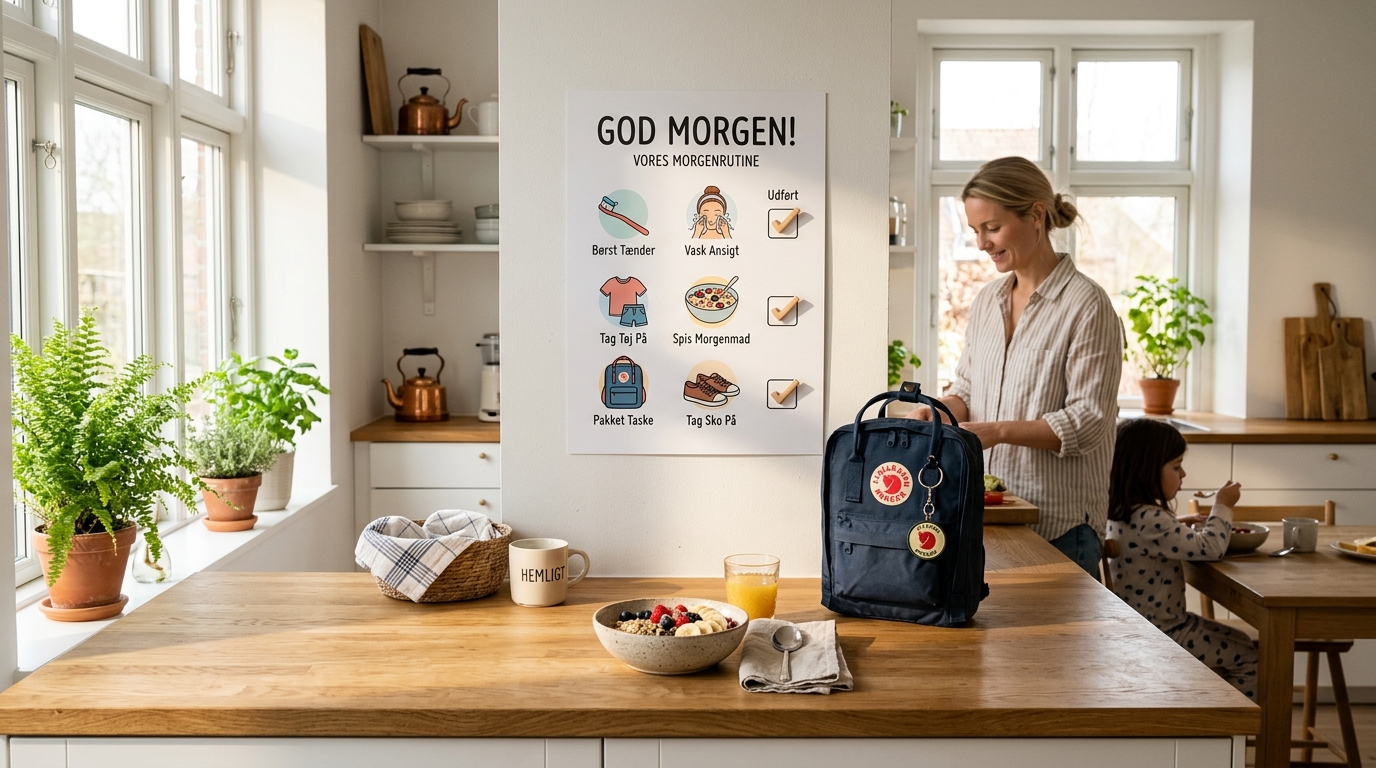
How to Create an Effective Visual Morning Routine for Kids with ADHD
Discover how neurodivergent children process executive function tasks in the morning and how visual, step-by-step printable sequence charts eliminate parent-child power struggles before the school bus arrives.
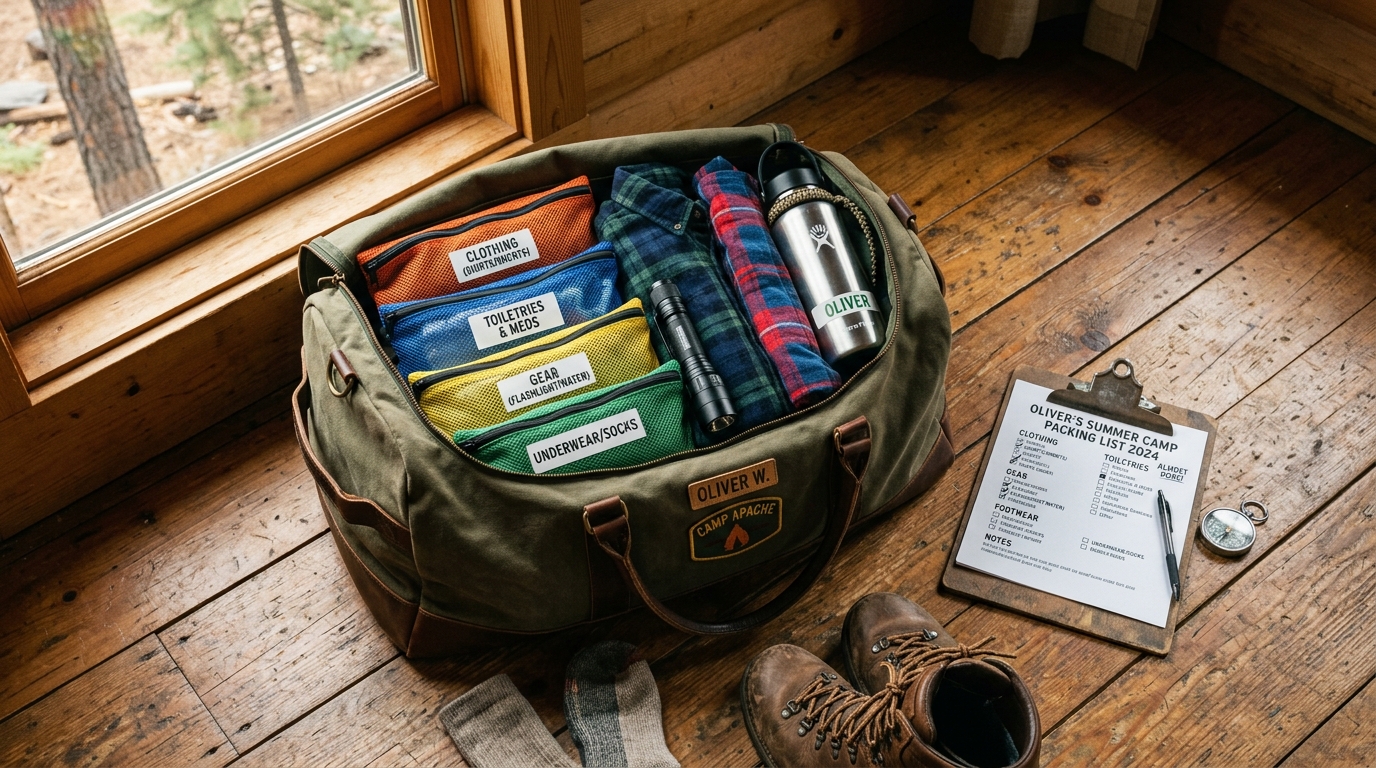
The Complete Sleepaway Camp Packing Guide & Checklist
Master the art of packing for 1 to 4+ weeks of overnight camp without losing clothes, missing essential medications, or overpacking bulky gear.
How to Teach Teens Smart Money Habits: Practical Savings Guide & Printable Tracker
Transition teens from coin piggy banks to real-world budgeting systems that manage allowances, part-time jobs, car savings, and discretionary spending with clear visual accountability.
The Ultimate Family Routine Blueprint: Free Printable Systems, Schedules & Checklists
A master tactical guide for parents seeking to replace morning yelling, after-school chaos, and mealtime stress with predictable, visual physical systems. Features step-by-step frameworks for morning launches, homework stations, meal planning, chore accountability, and school keepsakes.